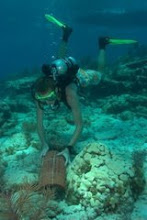
There are many adventures I have yet to recount to you all - the January research cruise, the trip to Lebanon, and a future post on the good things at KAUST, including my cool housing. Now rushed for imminent departure to Ecuador with Erin, I chose not to pack my laptop - and figured it would be a shame to not share some photos from a research trip I just returned from.
This last trip was fantastic. In an effort to maximize the utility of KAUST funding for the sake of reef fish ecology, tens of thousands of dollars of acoustic transducers (pingers and receivers) were purchased for the sake of tracking reef fishes and learning more about where it is they go, among other things. Using that money means learning lots of new skills, especially since the transducer company's (VEMCO) workers came down to help us design the field arrays, deploy receivers for range testing, retrieve data, and analyze patterns in data. I learned how to do all of these things.
I also learned how to perform surgeries on fish to implant acoustic pingers into the body cavity, so that fish can be detected when they swim by our receivers on the reef. I never considered myself steady enough to be a surgeon, but I sewed up a dead grouper OK:
With these new field skills, I can dream up and achieve future projects to fit together small pieces of the puzzle of reef fish population dynamics in the Red Sea. Exciting for me.
Most awesome of all - swimming with young whale sharks. We know almost nothing about this gigantic fish, so a side project here is to tag and track whale sharks, too. Down in Al-Lith is one of the prime spots to see whale sharks in the spring time. And we were lucky enough to see them. With maybe four or five different sharks in total over the last several days, I was lucky enough to swim with them a few times. Most of the time they move at an incredible pace, difficult to keep up with, but I was lucky enough to go eye-to-eye with these gentle plankton feeders for mere minutes before the fish dove down into the depths again. Most fortuitous, on my last day we chanced to swim with a young shark for nearly half an hour, our presence no more cumbersome to him than a fly to us...


This young nine or ten foot male hung out at the surface with us, gulping plankton, and lazily moving around at 60-80 feet above a coral reef. It was one of the most fascinating experiences I have ever been lucky enough to have. We were working so hard all week that I didn't even get enough sleep to believe I wasn't dreaming. When I am at sea, studying reefs and who lives there, I begin to lose sight of the differences between reality and dreams - when on the reef, I'm living them.
Tuesday, March 23, 2010
The Wonderful Life Aquatic
Thursday, March 11, 2010
Charistmatic KAUST Beach Animals!
Several weeks ago, KAUST workers finished construction of our wonderful new beach. While there are many features that are not yet available, a swimming area has been roped off for exploration. I have visited the beach three times now, and have been delighted to finally explore an intertidal Red Sea ecosystem at my leisure (i.e. all day). Yet many snorkelers have been unhappy with the turbidity (“dirty-ness,” lack of clarity), claiming that snorkeling yields no sights. The turbidity issue is due to the fact that a lot of new sediment has been added to the area (our beach is actually imported – I disapprove, but moving on) and the swimming area is between two long spits of land that have been extended for the purpose of construction, flanking the swimming area with even more sand… Yet there is much to see at the KAUST beach as long as you slow down, cover a lot of area, and swim down to the bottom (only 2-3 meters) when snorkeling to get a closer look. The following photos (with cool informative captions) were all taken from within the swimming area of the KAUST beach, most below 1 meter depth. I invite you all to see the intertidal ecosystem you now have access to, but may have passed over; diver, snorkeler or just beachcomber, there is much to see!
Our first photo is of a pair of nudibranchs, Plakobranchus ocellatus, probably the first animal I saw at the KAUST beach. Found in even only centimeters of water, they eat macroalgae and actually save the chloroplasts within their own tissue to benefit from their ongoing photosynthesis!
A more detailed photo of the same species:
OK, so I cheated on the next photo - it was taken in a glass dish on the beach. But I found the slug pictured, Hypselodoris infucata, in a few centimeters of water on the beach, so you could too! It eats sponges, and is awesomely colored - a typical trait of numerous nudibranchs.
Just some coral with a runner of macroalgae growing above it; perhaps 50 cm deep...
Giant clam (Tridacna sp.) with macroalgae nearby. Giant clams rock because they use the same algal symbionts corals do in their mantle tissues to photosynthesize and grow!
A cool blue sponge (phylum porifera). These filter the seawater for food - I read recently that some species of sponges have been found to remove even viral particles from seawater as food - very efficient animal filters!
What is this? Some macroalgae?
No! It's a cowrie! A type of snail, kinda. The fleshy brown branchy stuff in the previous picture is actually part of their mantle tissue, which they raise up over their shell for camouflage. Spook them, and they retract into their shell, revealing its bright pattern.
No, it's not an eel. My Irish friend Damien holds an easily caught pipefish, an animal related to seahorses and very easy to approach underwater.
Now this is an eel. I can't believe I found one here! Again, it's perhaps half a meter deep - and this lil guy is only about as thick as one of my fingers - but that didn't keep him from threatening with an open mouth display of tiny (developing!) teeth!
A cool hermit crab has stolen some unfortunate snail's shell...
One of my favourite pics from today, this is an upside-down jellyfish (Cassiopeia xamachana), distributed tropically world-wide. It uses algal symbionts in some of its tentacles to photosynthesize like a coral! And if one symbiosis wasn't enough, you might be able to see tiny larval crustaceans (shrimp?) swimming above the tentacles - I have video and will upload it sometime. Ask me if you're curious.
So I cheated a bit on this photo - I adjusted the color levels so you could see it. Still, a cool upload. Came across this little puffer in a half meter of water; it got spooked and swam away. Puffers are known for their production of tetrodotoxin, which affects the central nervous system. So, don't eat them - unless you are in Japan where they will prepare you a special portion based on your weight, age and sex that won't kill you but will bring you to the edge (fugu).
Finally, a shot from maybe 1.5 meters depth. Looking to the surface over a coral head, you can see lots of juvenile snappers (Lutjanus ehrenbergi) hunting here in the shallows for benthic invertebrate food - much safer than the dangerous reef until they grow larger. Beautiful!
For any KAUSTers, I go to the beach most weekends, and would love to share more with you. Life is everywhere in the sea!
Sunday, February 7, 2010
Arabian Gulf vs. Red Sea (Noah in Kuwait)
NOTE: Photos to be added soon! Check back!
Months later, as I reflect on this November 2009 trip with a Kuwaiti friend that did not come along, I find I can't really answer his simple question - "Why would you go to Kuwait?" Indeed, Kuwait's policy toward alcohol is the same as Saudi's. That was OK; for me, it became all about the fish (as per usual). But looking back on the night before the flight, hanging in the library with Anthony and listening to Ernesto prod us over the phone to go, it was just about the adventure. So Anthony and I just bought the ticket.
So eager were Ernesto & the Mexican musketeers that came along that they neglected to check if Mexicans were even allowed into Kuwait. According to the look on the Kuwaiti official's face and the names on the return tickets he was holding out to the Mexicans as soon as we landed, it was evident that they were not. Familiar with Middle Eastern politic, we knew that rules can be sidestepped. So we sidestepped around the official, offering nods that translated to a polite "no thank you" and went on to the immigration desk, leaving him helplessly confused in our youthful wake. Due to the mishap, instead of five hours of total transit from KSA to Kuwait City, it took us about 13 hours - losing our first day - but successfully negotiating Mexican nationals into Kuwait is no simple task. What we learned for the future? Carry a copy of your university degree in your e-mail inbox, and bring SCUBA fins; you will be considered a professional and allowed entry. The musketeers sallied forth, veritable Don Quixotes fending off windmills (where 'windmill' means 'Kuwaiti immigration'). (For weeks afterwards we would jest: "Do you have your fins? OK, welcome to Kuwait.")
About those SCUBA fins... The Mexican musketeers were newly SCUBA certified and wanted to dive around the Middle East. Fantastic idea, I thought. Before leaving, it dawned on me that of course, the Arabian/Persian Gulf (from here on, just "the Gulf") was an entirely different basin with a unique biological assemblage to explore! (The artifact of the basin's "name" depends on who you call your friend - Middle Eastern nations openly befriend, and secretly scorn each other - for entertainment, perhaps? Just say "Arabian" when in Arab countries and "Persian" when in Iran. Also, don't ask a Kuwaiti taxi driver if he "likes" Iraq.)
Before departure, I set out to compare the "the Gulf" with my new home country's west coast wonder, the Red Sea. Why would anyone care? Well, see the below map, and the accompanying chart of lightly researched facts of biological interest...
The Red Sea is significantly warmer and saltier than the Gulf. The Gulf is situated overall at higher latitude (farther North) than the Red Sea. In addition, unlike the Red Sea, it receives massive freshwater input from the fertile Tigris-Euphrates river drainage (which delineates Iraq's southeastern border). The Gulf also has a much wider mouth to the Indian Ocean than the Red Sea. (Though the Red Sea does receive water from the Mediterannean through the Suez Canal, I'd guess this would be negligible, except for its role as a vector for non-native species exchange.) The Gulf's coastal freshwater input also means more nutrients, and therefore more turbid water due to higher densities of phytoplankton growth. These factors affect biodiversity; while FishBase.org lists 1,220 fish species known from the Red Sea, only 772 are known from the Gulf. Surely a dive in the Gulf would be a vastly different experience thana dive in the Red Sea.
Aside from the natural, there is the anthropogenic to consider. The Persian Gulf witnessed mankind's 1991 Gulf War, in which a coalition of nations aided Kuwait in chasing out Iraqi invaders. Iraq's exit strategy while fleeing was to cause as much damage to Kuwaiti economy as possible - and the easiest way to do that was to destroy its natural resources. The retreating army lit oil fields on fire, evacuated oil tankers of their payload, and wrecked coastal refineries - all releasing oil into the Gulf... According to Wikipedia, "...estimates on the volume spilled range from 42 to 462 million gallons; the slick reached a maximum size of 101 by 42 miles and was 5 inches thick. Despite the uncertainty surrounding the size of the spill, figures place it 5 to 27 times the size (in gallons spilled) of the Exxon Valdez oil spill..." I was curious if I'd be able to find evidence of this environmental disaster out on the reefs, even ten years later.
Still there? As if this post hasn't been geeky enough, my curiosity pushed me to search through the scientific journals to find out if some reef biologist had already looked at the Gulf War's damage. I found a 1993 paper called "Has the Gulf War Affected Coral Reefs of the Northwestern Gulf?" Without including a detailed review of the paper, I'll say that while the techniques used were fairly weak, the minimal amount of data support the authors' conclusions that any damage that had been done to coral cover, coral abundance, fish diversity, fish abundance, and/or urchin abundance had more or less recovered by late 1992. While there were significant differences between some of the ecological parameters mentioned before and after the war at certain sites, the authors chastised naysayers: “The most convenient explanation for the coral mortalities observed, and for the decline in the fish community at Kubbar, is to blame the Gulf War in some way. For example, there was always the possibility that long term effects (from temperature drop, soot fall-out, decreased insolation or toxic effects of oil) would manifest themselves in changes to the coral reef community. However, the changes recorded above, with the exception of Qit'at Urayfijan are relatively small, cannot easily be traced to a particular cause, and have, in some form, happened previously without the benefit of a war to blame.”
Yet, a bit of a deus-ex-machina for those waiting on bated breath to read the cathartic summary of my Kuwait dives. C'mon people, I visited without scientific equipment (i.e. measuring tape and a clipboard), and it was more about curiosity than data. Although, oddly enough, I dove Qit'at Urayfijan, the exception-to-recovery reef from above, and it wasn't your picture perfect reef. Of course, I had no perfect pictures anyhow because I accidentally left my camera in KSA, and we had to squish another camera in my housing to snap off the shot or two posted here.
So what can I say? The water was noticeably colder and pea-green, with perhaps five meters of visibility; there was significantly less coral diversity and coral cover than any reef I've been to in the Red Sea, and significantly less fish abundance and probably fish diversity. The reef was mostly coral rubble with the occasional isolated coral head or patch of solid dead coral rock, popular with the large urchin population. An adjoining wreck was sprinkled with coral growth. After one day of diving at one site, it would be impossible to identify the impact of oil spills from surface-level human affairs. But it was still, as the Silent World always is, magical.
There is more to Kuwait then the neighboring body of water, and we made good on our time to explore. But Kuwait is still very small. It is nearly impossible to get a taxi there; most people in Kuwait have money - it has the most expensive currency in the world, at US $3.50 to a Kuwaiti dinar (KD). So walk we did, throughout much of Kuwait City, for hours, failing to get taxis. Our two nights in Kuwait saw the two most important sites to visit - the souq and the Kuwait Tower. The souq, one of the richest in the Middle East, was beautifully clean and, to my horror, sold sharks in the fish market. Outside, I smoked my first sheesha while Kuwaiti children ran around setting off tiny, loud firecrackers every three seconds. The Kuwait Towers, more or less the country's national monument, is a series of three concrete spires, the highest of which is 187 meters. An elevator takes tourists to the top where a rotating dining area allowed diners a 360 degree view of the city every 30 minutes. In addition, you can enjoy photographs of Gulf War destruction caused by "the barbaric invaders," according to captions. Overall, I found it the least friendly city of any I've been to in the Middle East, in that there just didn't seem to be anything to do. I might go back some time in the summer when the whale sharks make it to the Gulf; for now my judgments lay in purgatory.
Wednesday, January 20, 2010
"What do you think is the culture of KAUST?"
Said the man with the camcorder. We'll call him Mohammed, to keep things anonymous. His plan was to bring 30-ish 30-second video responses to that inquiry to "upper administration," including a few members of the Board of Trustees, to try to get them to understand what is going on amongst us. Us, the queer commoners.
You'll see that my blog has not been updated since November. That is not for lack of adventure or insight; for I have had both. I will retroactively post some of these adventures for you all to read. But, life on campus has become a bit foggy to report in a straightforward sense; maybe it's because I watched "Fear & Loathing in Las Vegas" last night that I feel sufficiently spacy to finally report. The man with the camcorder who asked me the question I started this blog with was finally evidence (for me) that we weren't a bunch of complaining, whiny expatriates - we were somewhat of a lost community trying desperately to reach out to - well, something in upper administration that we hadn't been finding.
Mohammed assured me that I should have no fear; that I should be bold in my response. (Usually negative criticisms always come with a shadow of fear attached, especially when dealing with corporations as spectral as KAUST's administration.) He assured me that if I changed my mind even the next morning, I could write him an e-mail and he would delete my video response. I said 'I think we are all unified in our sense of being completely confused.' Well, I didn't change my mind. I can only hope that those who saw my comment seek to understand and solve, rather than to dismiss.
How did we start thinking this way? As another anonymous staff member told me, who is intimately familiar with real battlefields, "there's no way to explain the situation to those who are outside of it." But I'll try anyways.
The problem with "explaining it" is that "it" appears to be a list of small complaints:
- How come my home's fire alarm still doesn't work? How come the staff come to "look" at it every week or so and tell me that I myself need to do something about it, when they have the keys to my fire alarm system panel?
- How come I have to wander the whole library before finding a computer that can send a print job to a real printer?
- Why don't we have access to scientific journals?
- How come I am charged differently every night I go to the dining commons, even though I get the same thing?
- How come my new apartment's bathroom floods? How come there are only 360 students here, on a campus supposed to serve 2000 students at maturity, yet five months past our arrival we can't sufficiently house even this meager number?
- Why can't we get our textbooks on campus?
As I've explained to some friends and family, reading this as the list of complaints makes any student in agreement with them seem like an ungrateful heathen. But there is a difference between reading about annoyances and living with them. If I were to wax poetic, i.e. "swarms of mosquitoes / give students ferocious bites / curse them in their pain" you might laugh out loud as our haiku's protagonists contend with tiny flying insects. But you wouldn't want to be one of the poem's students. Symbolic insects of all kinds are nipping at us from all angles; none too lethal alone, but their collective effect is maddening. (Metaphorical poetry aside, the numerous mosquitoes on campus have already caused a few cases of Dengue fever. To curb their multiplication, the university advised the community to prevent creation of standing water. Shall we disconnect your stagnant fountains, then? At least we managed to change the chemical-spraying truck schedule so that our faces were not bombarded by the funny-smelling smoke while walking to supper.)
Returning to the point, the initial pain from such issues resonates longer. Problems have not been solved logically by stating the problem and receiving a solution; getting printers to print from anywhere in the library is not a five month long job, but five months of complaints stream in. Are we to eventually silence our little complaints, and be happy X years down the road, when all is finished, and forget the past? Certainly we might forget after graduating and going home, and KAUST would carry on, attempting a second round of success with the second class of students. Unfortunately, I am not here for X years; I am here for one and a half. If KAUST is "fixed" in X years, I probably won't be here to see it.
Worse, not all problems are small ones. As many faculty have admitted to me, one of the most difficult things about making demands on the administration to hurry up is that they are a "moving target;" responsibility for one thing or another is traded from one overworked, undertrained person to another. When one person begins to take responsibility on themselves, appearing to go "rogue" perhaps from the ethereal big cheeses' points of view, they are let go. This has happened to a friend of mine. Or, honestly, maybe that wasn't the reason for his/her termination; the point is, we won't be informed, and we'll instead need to form a new relationship with a new overworked person and try to get them to solve the same problem we've already explained multiple times.
When we shout these complaints out, however large, they enter a void; a "black hole," if you will. When KAUST's researchers/faculty, some of the most intelligent scientists on the face of the planet, pestered those responsible for laboratory construction once again for a deadline, they were told labs would be ready in May, and not to ask anymore, that no more questions would be answered. What a slap in the face! Would you tell Einstein that no, he couldn't have a room for his experimentation yet so be quiet and relax? Do we expect such treatment will retain such creative minds? Regarding the promises of "labs in May," those same promise-granters (or different? how many contractors have we cycled through now?) promised "temporary" labs would be done in September, which still have not been completed. A bike ride to the interdisciplinary marine science center reveals it as little more than a concrete husk with dirt floors; no pipes, no wires, and some broken glass doors. May, you say? Meanwhile, researchers who have earned Nobel prizes and sequenced genomes are donning their golf bags and hitting the green, as they have neither the place nor the equipment needed to create the knowledge that will change the world, something they were hoping for here. What a waste of intelligence.
And this has taken me a while to write about at all because I worry. I worry about being asked to leave KAUST. I worry that I will be booted in exchange for a student who will not speak their mind - or worse, a student who will not care either way for the vision of KAUST. Speaking your mind seems offensive and standoffish here; behaving, being grateful, and accepting what has been given appears to be all that was anticipated of us students. We can't tell; the lack of transparency leaves our questions unanswered.
But here is the most important part of this lengthy outcry; if you don't read this, then you won't understand my intentions from the preceding rant alone. I speak my mind not as one disenfranchised with KAUST, as a blasphemer trying to damage the institution that has already given me so much (the chance to meet and discuss science with one of the most fantastic researchers I've ever met). Instead, I am pleading for progress. The postcard image of this university, the grand idea, is supremely laudable - I wish to achieve here, at this school, for the Kingdom of Saudi Arabia and for the world - but progress is sluggish. What quality of professors and researchers does KAUST expect to retain, if those that can't make progress decide to leave? These are not isolated incidents; they are people with hearts and minds and mouths that will spread the news to their 63 countries. Although no student has been asked to leave KAUST, to cover my own fears I inquire the same - what quality of student does KAUST expect to receive if those who are upset that they cannot push the limits, to discover, as my very scholarship is named, are relieved? Please, to anyone who may understand what controls the fate of this place, let us build, let us create, let us grow and fulfill the dream of KAUST.
No word from Mohammed about the response to the KAUST culture video. Hopefully it enlightens. Hopefully we can start to answer our questions.
Sunday, November 22, 2009
KSA, oil & the world: thoughts from Shaybah (retro post)
On October 22nd, 2009 the KAUST Student Council, KAUST student affairs, and the Saudi Arabian oil company ARAMCO (also responsible for most of campus construction, planning, etc) flew, a jet full of students, for free, to the oil fields at Shaybah (a 4 hour flight), in the Saudi Arabian "Empty Quarter," kinda the toe of the boot of the Arabian peninsula, just west of the UAE and Oman. It was in order to share the wonder of human engineering with KSA's future engineers at KAUST. There, we were treated to a very short tour of the facilities, as well as allowed to romp around the beautiful open desert sand dunes that stretch for hundeds of kilometers in all directions at sunset, and then served a roasted lamb dinner. After, there was a presentation about the faciliy, from which you can learn all the facts you need to know from this excellent video they played for us. Watch it; it is very good and gives many insights about KSA, Aramco, fuel, and the world. The rest of this blog post contains photos taken by me and others from the trip as well as excerpts of my thoughts that day regarding fossil fuels and human civilization, taken from my Saudi Travel Notebook... (Note I don't edit the grammar from the notebook - it's the diltuted form of insights I sometimes share on the blog. Another reason I hardly edit: retro-actively understanding the concepts I've put on paper can be tough.)
Can't wait to send photos home; here I look at where dead dinosaurs get pulled from the ground & changed into your fuel... I visit the place where your car's engines know intimately; suddenly, all your past vehicles & I have a common link... FIND OUT on this trip the markets for this product - could I have gassed up w/ Shaybah fuel before?


it's certainly sobering to sit here on top of so much natural resource - so much of what drives my home country crazy - & to think that what differet cultures had built atop of them, & whether some Gaia-like influence has chosen to push the paths of these peoples in one way or another...
Now watching PR video... all about Saudi inegnuity, Saudi goals, & man's ability to create - to achieve - but funny that all began as American-created company, & all this happy-go-lucky achivement stuff in order to serve the developed nations of the world fuel for their polluting vehicles; the Saudi ingenuity and oil harvesting technologies & skills all serve to [do that... to] subsidize global transport... help you get to work...

What if U.S.A. located on [this much] oil & had fields like these? [i.e. interesting that the U.S. is not.] To think that instead of just distance seperating product from markets, there are cultures...


"Any organic farming [here at Shaybah]?" asks a be-abaya'd woman visiting with us -
"No." Our guide says, flatly.
Sustainability, 'self-sufficiency' DENIED. [i.e. all imported, flown in on plane.]
If it's not from the sun, it's from the oil... Sun moves the biosphere, atmosphere, hydrosphere... OIL moves the anthrosphere... [We are part of the biosphere, yet our actions aren't mere flows of interactions between animals... we are literally] carving out the planet for our [excessive] existence...
When I go back and read this post now, I just think you will all find it confusing and reminiscent of dirty hippie. But Shaybah was large; something like 1/4 of all KSA production or something. And it put into perspective the money just to fly us out there, and indeed the money for KAUST... it was all very interesting. Hoping you could catch some of that in this post.
Friday, October 23, 2009
Two Weeks with the Red Sea
The Obeamyway Peninsula. A remote and fascinating region teeming with marine life. We chose these mysterious waters as the Belafonte's next stop.
For those of you that missed the reference, it's from The Life Aquatic with Steve Zissou, and it's amazing. The movie is a somewhat bluntly satirical postmortem celebration of the life and times of Jacques Yves Cousteau, that beloved and famous French oceanographer & SCUBA co-inventor. And it's the sort of nostalgic scientific enjoyment I was experiencing daily on our vessel. Heck, we even brought glocks (replicae, of course).
We visited each of the sites on the map below on a cruise from North to South and back again in the Saudi Arabian Red Sea...
I'm not sure how to share this trip with you. To share a portion of what I wrote while on the cruise, "Memories & research cruises don't go well together; think blur with bright patches; like a Jackson Pollock with the occasional chartreuse smear. Its very anachronistic, just a collection of amazing moments with shady/fuzzy links between them (i.e. was the white tip @ Canyon? Or was it before the sea turtle?). The other [researchers on the boat] must just enjoy it, & end up with the data they need... no problem... sort of a 'surprise, you have samples to work with [back in the lab]' kind of memory... Though it was all planned out beforehand, like a composed orchestra, it cannot be reconstructed however meticulously by the listener from a single performance... I guess we just enjoy it... Learn what lessons you can, here & there..."


My thoughts on paper sway like the swell of the sea, and my apologies if they don't make sense. If we meet in person and drink beer together in the future and talk about this trip, you and I, I can show you some photos and tell you that this trip was key for my experience at KAUST. It has been the first reassurance that KAUST could be a good place for me to do research, and that the researcher I want to work with is an incredibly cool person. 
I learned more on this trip about the current research techniques in understanding the life histories of reef fishes - what they do, why, where they go, where they're from, where they grew up, why they only eat this coral, who they're friends with... I learned how to identify a few dozen more species of reef animals (mostly fish) in this part of the world, including some endemic (Red Sea only) species... I learned how to throw a cast net, how to keep cuts and scratches taped up to keep them from getting worse even after hours in the sea, how to cut out the sagittal otolith bones from the neurocraniums of Actinopterygiian fishes, how to catch & clip clownfish, and how to play bananagrams.
[Above, cool photo Justin took of Red Sea ghost crab, an endemic sp. w/cool eyes!]
But it was not some drift off into wonderland, some heralded exclusive for a few lucky scientists to discuss life and love and coral reefs. In fact, there were only a few in depth conversations I had over the two weeks - with the cool researcher/PI/boss regarding what I was interested in & what I thought reef conservation needed and where I wanted to go with it; with a last-year WHOI PhD student regarding fish life history, grad school, otoliths and girlfriends; with cool researcher's assistant about conservation, hippies, communal farming and the reefs of Kimbe Bay, Papua New Guinea... Most days consisted of three good Filipino-cooked meals, lots of water to drink, several hours of diving and catching, measuring and clipping the fins of spunky clownfish - then back on the boat for data recording, relaxing, planning the next cruise location, playing guitar, watching a movie, swimming in the bioluminescent waters off the boat at night, or catching little fish from the transom...


So, since I told myself to keep these post short, and to honor the anachronism and mire of the memories of the voyage that ended nearly a month ago, I'll just share a few random excerpts from the journal and put up a few more pictures. Ask me more in December over a nice winter warmer while the snow falls outside, far from the reefs.

Excerpt from 10/4/09
"In bed, just thought how funny would it be to tell a total stranger... about the day's activities? Here I am on a boat snug-as-a-bug reading a book about Red Sea marine life; rather, studying and memorizing fish species... wondering about their diets, their availability in the aquarium trade, their captive care... their ease of capture, their abundance on reefs, their otoliths, their population structure and dynamics... why do I have to pick one question? Do I? & why must it be "relevant"? to what need it be "relevant"? And how funny would any of this be to someone else...


Excerpt from 10/6/09
"We even did a night dive. Not enough lights for all of us, but nearly full moon so it bright enough... Just to play in sand w/bioluminescent dinoflagellates was enough for me. No responsibilities, just play - & night dive the best time to do so on a reef. You feel like a member of the club, unified, your secret sea home, a place to play & sleep and do handstands & eat coral & fight eels & chew lil reef shrimp & grunt at competing males... Mike even brought some of our dead fish to try to get sharks in, but we never did... I was worried at first, but it's really the live & inured fish that get sharks excited... otherwise they're too scared to come just cuz you smell like fish... Mike DID put two on the reef before we left though & they were gone when we got back..." [Photos are lionfish hunting over reef at night, scorpionfish perched on coral branches, and octopus tucked down inside a coral]


Excerpt from 10/9/09
"Up @ 11 this morning [late] cuz sat phone peaches last night for ~15 mins [after all the night's activities]. There were squid off the stern last night; five, in a line next to each other - probably the reef squid Sepioteuthis lessioniana - short lifespans, mature in ten months!" [I was thinking about how she was in a car with friends during the call, going out, to an opera? And I'm staring at squid at like 3 am rocking over the reef... The photo I posted below is one I took of Erin and I if we lived as reef fish buddies... I thought of this immediately when I saw the juvenile goatfish and the juvenile bird wrasse hanging out together. Of course, Erin's the bird wrasse (above) and I'm the goatfish (below)... & I know they're juveniles, but like my sister said, we really like to play together...]
Excerpt from 10/11/09
"An unbelievable evening - am I making it up? Sammy [our Filipino cook] made me a cake, w/FROSTING, & my own chicken for dinner!" [The chicken had a flag stuck in it that said "Happy 21st B-Day NOAH," and all of this was after a dusk dive where I "found" an angelfish-shaped card made from underwater paper with everyone's signature on it down on the reef...]


So what did I do when I got back to shore, two weeks of classes to catch up on, and three make-up tests?
Tyler: Dude, do you want to go diving?
Noah: Uhm, I have this one weekend to catch up on tests and work and yadda yadda and I just did a lot of diving...
Tyler: Soooo.....
Noah: Well, yeah, okay.